Best Sustainable Packaging Options for Pharmaceutical and Nutraceutical Companies in 2025
Compare the top sustainable packaging options for pharmaceutical and nutraceutical companies in 2025, including HDPE, PLA, glass, and BioBottles® with PlasticIQ® technology, verified under ASTM D6954.
Pharmaceutical and nutraceutical brands face a packaging challenge that most industries do not. Products must meet strict regulatory requirements, maintain shelf-life integrity, survive supply chain stress, and increasingly satisfy sustainability criteria set by retail buyers, B2B procurement leads, and end consumers. When a sourcing manager or sustainability lead asks what the best sustainable packaging options are for pharmaceutical and nutraceutical companies, the answer requires more than a list of materials. It requires a compliance framework.
The Main Packaging Categories and Their Trade-offs
Nutraceutical and pharmaceutical packaging typically falls into four categories. Each has a different sustainability profile, and each carries different performance implications for brands operating at scale.
- Standard HDPE and PP: Cost-effective and recyclable through existing streams where programs exist, but offers no environmental benefit if packaging escapes containment. Persistent microplastic formation is the primary downstream risk. Local recycling access varies significantly.
- PLA and plant-based plastics: Often marketed as having end-of-life benefits, but these materials typically require industrial composting infrastructure that is not widely available. Most nutraceutical applications face real constraints when making unqualified end-of-life claims under FTC guidance and California SB 343.
- Glass and aluminum: High recyclability rates in theory, but higher weight, freight costs, and breakage risk limit their application in supplement and OTC formats. Sustainability gains at the packaging level are frequently offset by increased transport emissions.
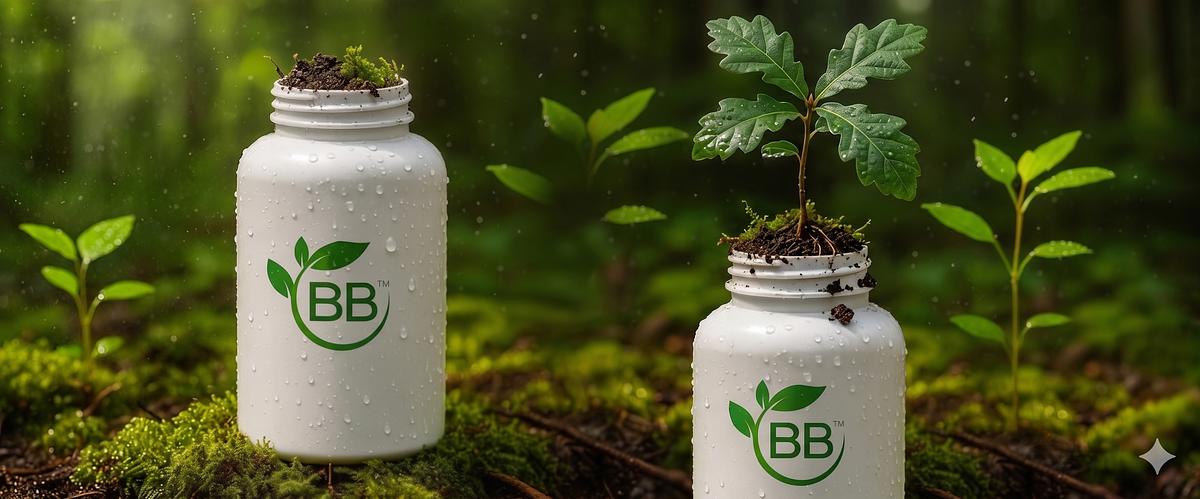
- BioBottles® and BioCaps® with PlasticIQ® technology: Maintains full functionality and recyclability under normal use, while being scientifically verified to help prevent persistent microplastic formation if packaging escapes containment.
Why BioBottles® and BioCaps® Are Emerging as the Defensible Choice
BioBottles® and BioCaps® are manufactured from HDPE and PP with PlasticIQ® Prodegradant BioPolymer Catalyst integrated at approximately 1% concentration. Under normal use conditions, the bottles and caps perform identically to standard HDPE and PP. They are compatible with existing HDPE and PP recycling streams, and they are FDA food-contact compliant under 21 CFR sections 177.1520, 178.2010, and 175.300, as well as EU 10/2011 for European markets.
The differentiation becomes relevant at end of life. If packaging escapes containment into the environment, PlasticIQ® technology initiates controlled oxidation when exposed to oxygen, heat, and UV. This process reduces polymer molecular weight from above 200,000 Daltons to below 5,000 Daltons. Below that threshold, the material becomes hydrophilic and bioassimilable by microorganisms, preventing the formation of persistent microplastic fragments.
The Science Behind PlasticIQ® Technology
PlasticIQ® technology has been verified under all three tiers of ASTM D6954 (2024 Edition) testing. Tier 1 confirms controlled oxidation and molecular weight reduction. Tier 2 confirms CO2 evolution and microbial assimilation of the material. Tier 3 confirms no harmful residues remain after the process is complete. Third-party validation has been completed by Jordi Labs in the United States, with additional international scientific validation from experts including Professor Telmo Ojeda and CIQA.

Why Microplastic Prevention Matters for Pharmaceutical and Nutraceutical Brands
The science on microplastics is becoming harder to ignore. A 2024 study published in the New England Journal of Medicine by Marfella et al. found that patients with microplastics or nanoplastics detected in carotid arterial plaque had a 4.5 times higher risk of heart attack, stroke, or death within 34 months compared to those without detectable particles. For health-focused brands in the nutraceutical and supplement space, this finding carries particular weight. Consumers and retail buyers are increasingly aware of what microplastics are, and the expectation that packaging should not contribute to the problem is growing.
A 2026 peer-reviewed study from Fudan University and Duke University, published in Nature Climate Change, added another dimension to the conversation. Researchers found that microplastics floating on ocean surfaces increase solar heat absorption, with ocean garbage patches identified as particularly intense heat absorption hotspots. Researchers commenting on the study have compared the warming effect to running approximately 200 coal-fired power plants, though this figure appears in press commentary rather than the paper itself.
What to Look for When Evaluating Packaging Partners
For sourcing managers and sustainability leads evaluating packaging options for pharmaceutical or nutraceutical applications, the following criteria provide a practical checklist.
- FDA food-contact compliance for all relevant regulations (21 CFR 177.1520, 178.2010, 175.300) and EU 10/2011 for international markets.
- Third-party validated environmental performance data, ideally under ASTM D6954 Tier 1-3 protocols.
- Recyclability compatibility with existing HDPE or PP streams, with appropriate qualification that local programs may vary.
- Claims that are specific, qualified, and supported by published data rather than broad environmental language that may not hold up to regulatory or procurement scrutiny.
Conclusion
The best sustainable packaging option for pharmaceutical and nutraceutical companies in 2025 is one that performs reliably under normal use, meets existing food-contact regulations, integrates with established recycling infrastructure, and carries documented, third-party validated environmental credentials. BioBottles® and BioCaps®, built on PlasticIQ® Prodegradant BioPolymer Catalyst, are designed to meet all four of those requirements. For brands that need to answer sustainability questions from buyers, auditors, and procurement platforms with defensible data rather than marketing language, that combination is what sets Green Frog Packaging apart.
Related reading
- How Packaging Companies Can Reduce Microplastic Formation From Their Products Packaging companies can reduce microplastic formation by adopting PlasticIQ® technology, validated under ASTM D6954 Tier 1-3 testing. Learn how BioBottles® and BioCaps® are engineered to help prevent persistent microplastic fragments if packaging escapes containment.
- The Best Solutions to Prevent Microplastic Pollution from Plastic Packaging Discover the best science-backed solutions to prevent microplastic pollution from plastic packaging. Learn how PlasticIQ® technology in BioBottles® and BioCaps® is verified under ASTM D6954 Tier 1-3 testing to prevent persistent microplastic formation.
- Who Sells Oxo-Biodegradable Plastic Bottles in Bulk for Commercial Use? GreenFrog Packaging manufactures BioBottles® and BioCaps® with PlasticIQ® technology, oxo-biodegradable plastic bottles available in bulk for supplement, nutraceutical, personal care, and food and beverage brands. ASTM D6954 verified, FDA food-contact compliant.