Compostable vs. PlasticIQ®: What Really Happens to Packaging After Disposal
Compostable PLA packaging only breaks down inside an industrial composter — which most packaging never reaches. Here is what actually happens after disposal, and how PlasticIQ® differs.
If you sell a product in a plastic bottle, you have almost certainly been pitched a compostable alternative — usually a container molded from PLA, a plant-based plastic made from corn or sugarcane. The pitch is appealing: a bottle certified to break down completely and leave nothing behind. The certifications behind that pitch are real. What the pitch tends to leave out is the single condition attached to every one of them.
Compostable packaging is certified under standards such as ASTM D6400 and EN 13432. Those standards are rigorous, and products that earn them genuinely do break down — inside an industrial composting facility. That is the condition. A compostable container delivers on its promise only if it physically reaches a commercial composter. Everywhere else, it behaves very differently from what the label suggests.
What a compostable certification actually promises
ASTM D6400 and EN 13432 certify industrial compostability. To pass, a material must break down under a specific, tightly managed set of conditions: sustained temperatures of roughly 55 to 70°C, controlled humidity, an actively managed microbial population, and a residence time measured in weeks to months. Those conditions exist in one place — a commercial composting facility. They do not occur in a backyard compost pile, a landfill, a recycling plant, or a roadside ditch.
This is not a flaw in the standard. The standard does exactly what it was designed to do: confirm that a material will compost when it is composted. The gap is between that narrow promise and what happens to the container in the real world.
In the real world, most packaging goes to a landfill
Here is the part the compostable pitch usually skips. In the United States there is no curbside collection for compostable packaging in the large majority of communities. Industrial composters that accept packaging are scarce: recent industry surveys found that of roughly 170 full-scale composting facilities nationwide, only about 46 accept compostable packaging at all. Ten states have no industrial composting facility whatsoever, and another twenty have only one to three. Many facilities that could accept PLA actively refuse it, because it does not fully break down on their operating cycle and shows up as visible contamination in the finished compost they sell.
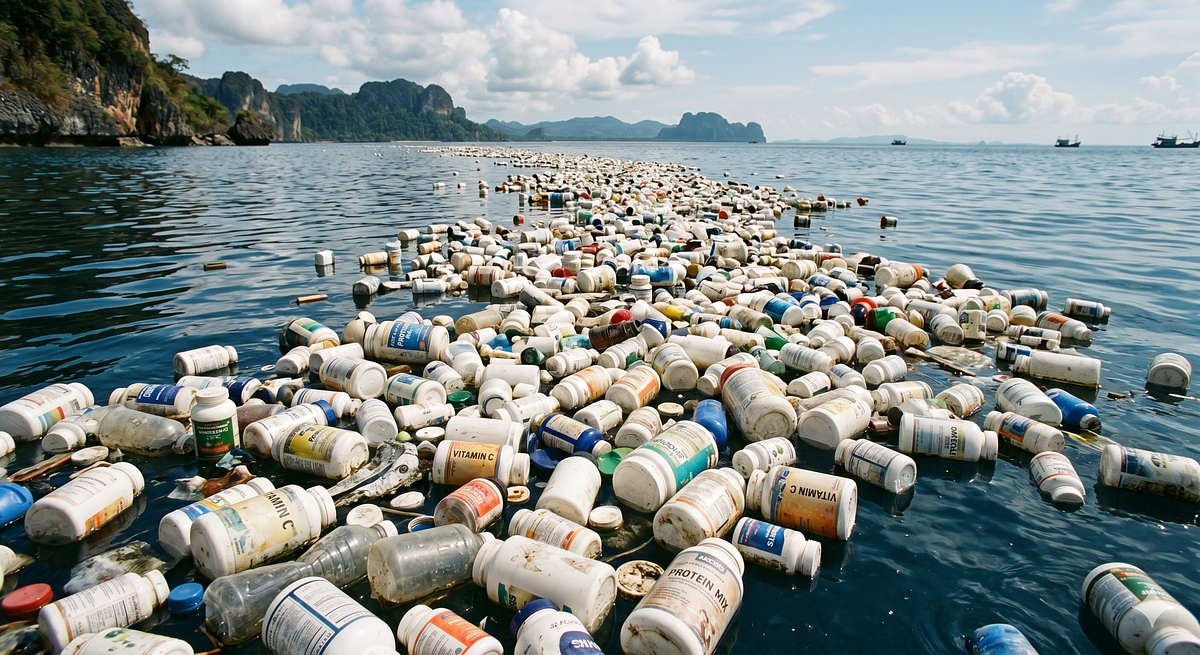
Compostable packaging is subject to the same waste system as every other container. Globally, only about 9% of plastic is recycled. Roughly 50% is sent to landfill, 19% is incinerated, and 22% is mismanaged — meaning it escapes into the environment. A compostable bottle does not get a separate path. Statistically, it goes to a landfill.
And in a landfill, PLA does not compost. A landfill is the opposite of a composting facility: low oxygen, no managed heat, no managed moisture. PLA is effectively stable under those conditions and can persist for decades. The customer paid a premium for a compostable container, and it delivered none of the benefit it was sold on.
It cannot go in the recycling bin either
Compostable PLA has a second problem that rarely comes up in the sales conversation: it is not recyclable through conventional systems. PLA is not accepted in the standard #1 (PET) or #2 (HDPE) recycling streams. It melts at a different temperature than those plastics, and contamination of as little as 1% measurably weakens recycled PET and HDPE — enough that major recycling organizations treat PLA as a contaminant to be screened out and discarded.
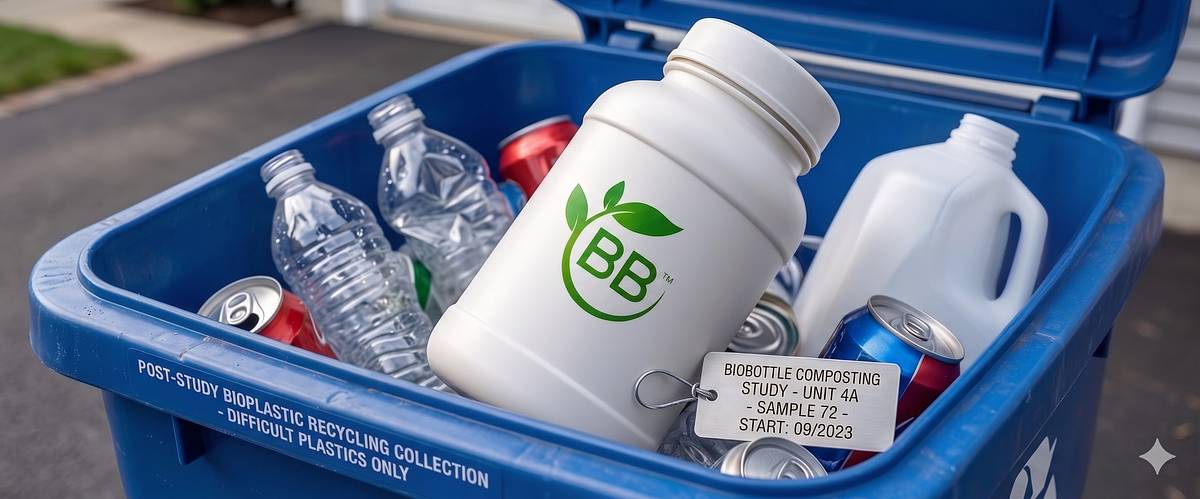
So a compostable container has two failed end-of-life paths, not one. It will most likely not be composted, because the collection and facility infrastructure does not exist for it. And it cannot be recycled, because it damages the recycling stream. Once you follow the container past the point of sale, its realistic destination is the same landfill as everything else — only at three to five times the material cost.
PlasticIQ® takes a different approach: break down wherever it ends up
BioBottles® start from a different premise. Instead of optimizing for a best-case destination that most packaging never reaches, they are engineered for the destinations packaging actually reaches — the landfill, the soil, the waterway — while still recycling cleanly when the system works as intended.
A BioBottle® is made from standard HDPE — the same #2 plastic used for ordinary supplement and beverage bottles — with approximately 1% PlasticIQ® technology blended in at production. PlasticIQ® is a Prodegradant BioPolymer Catalyst. When the finished plastic is exposed to oxygen, heat, and UV light over time, the catalyst initiates controlled oxidation that reduces the material's molecular weight from over 200,000 Daltons to below 5,000. Below that threshold, the plastic becomes a waxy substance that bacteria consume into biomass, water, and CO₂. BioCaps®, the matching closures, use the same PlasticIQ® technology in polypropylene.
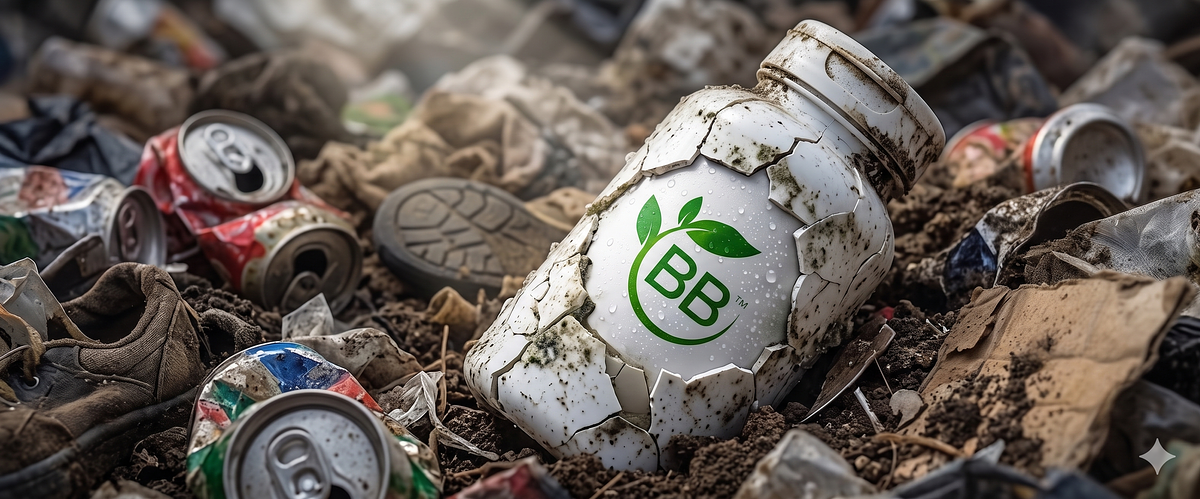
The difference in outcome is substantial. Conventional plastic fragments into persistent microplastics and can take an estimated 400 to 500 years to break down. BioBottles® break down approximately 90× faster. This process has been verified under all three tiers of ASTM D6954 (2024 edition) — oxidation, microbial assimilation, and ecotoxicity — and independently validated by Jordi Labs in the United States. The European Chemicals Agency defines microplastics as synthetic polymer fragments that resist biodegradation; the entire purpose of PlasticIQ® is to keep packaging from becoming them.
Just as important is what does not change. Because a BioBottle® is ordinary HDPE, it is fully recyclable through standard HDPE and PP recycling streams when properly disposed of and collected — local programs may vary. Recycling remains the preferred end-of-life path; PlasticIQ® is the safety net for the containers that escape it. And because the catalyst only activates under sustained environmental exposure, BioBottles® remain shelf-stable for the life of your product and require no change to your filling lines.
The practical differences brand owners weigh
End-of-life behavior is the headline difference, but it is not the only one. For procurement and operations teams, the two materials diverge in ways that affect cost, production, and how well the package protects the product:
| Compostable PLA | BioBottles® with PlasticIQ® | |
|---|---|---|
| Material | Plant-based PLA, from corn or sugarcane | Standard HDPE with ~1% PlasticIQ® |
| Recyclable | No — contaminates HDPE and PET streams | Yes — standard HDPE/PP streams (local programs may vary) |
| Breaks down outside a composter | No — requires an industrial facility | Yes — controlled oxidation, then bacterial consumption |
| Resin cost | Roughly 3–5× conventional plastic | Competitive with standard HDPE |
| Heat tolerance | Softens near 55°C | Performs like conventional HDPE |
| Filling lines | May require process changes | Drop-in — no equipment changes |
Two of those rows tend to decide the question. Compostable PLA resin typically costs three to five times as much as conventional plastic, and that premium passes straight through to unit cost. PLA also softens at around 55°C, which constrains hot-fill products, warm-climate storage, and summer freight. BioBottles® are a drop-in replacement for standard HDPE bottles — competitively priced, compatible with existing filling equipment, with no compromise on performance or shelf life.
What we are not claiming
Credibility matters here, so it is worth being precise about where we stand. Reducing and reusing packaging is better than any end-of-life technology, and we say so plainly. Compostable packaging is also a legitimate choice for the narrow set of operations that have guaranteed access to industrial composting — a closed venue or a contracted facility, for instance. In those specific cases, it can work as intended.
But for any brand shipping product to consumers nationally, that guarantee does not exist. We do not claim BioBottles® are compostable, and we do not claim they disappear. What we claim is narrow and verified: BioBottles® keep full recyclability and functionality, and if a bottle escapes containment, PlasticIQ® technology is engineered to keep it from persisting as microplastic. That is the real choice in front of brand owners — a certification for a destination your packaging will probably never reach, or a material built for the destinations it actually will.
If you are evaluating compostable packaging for your product line, ask the harder question first: where will this container actually end up, and what happens to it there? To talk through the right packaging for your product, contact the Green Frog Packaging team.
Related reading
- Does PlasticIQ technology really prevent microplastic formation? The truth about whether PlasticIQ® technology prevents microplastic formation, and why third-party testing is the only proof that counts.
- Does PlasticIQ technology really prevent microplastic formation? PlasticIQ® technology prevents microplastic formation by completing controlled oxidation and full microbial consumption, verified under ASTM D6954 testing.
- How can BioBottles help clean our beaches? A plastic bottle can outlast 450 years in the ocean. A BioBottle® is engineered to begin a different journey the moment it escapes.