How Packaging Stops Plastic From Becoming Microplastics
Discover packaging technologies that stop plastic from becoming microplastics, and why most "degradable" plastic fails the test that matters.
Pick up a "degradable" plastic package and read the label. It promises the material will fall apart. That part is true. Here is the part the label leaves off: falling apart is exactly the problem.
A lot of packaging marketed as a green upgrade is engineered to fragment fast. It cracks, crumbles, and breaks into pieces. The pieces get smaller. Then they get small enough that nobody is counting them anymore. The package "degraded." It also just became microplastics, faster than the conventional plastic it replaced.
You are probably thinking there is no way that passes a real test. It passes a real test. That is the whole trick.
The test that stops where the damage starts
The standard for this category of material is ASTM D6954. It runs in three tiers.
- Tier 1 measures oxidation and molecular weight loss. Does the polymer chain break? Does the material lose mass and fall apart?
- Tier 2 measures biodegradation. Do microorganisms actually consume the fragments and convert them to CO2?
- Tier 3 measures ecotoxicity. Do the leftovers poison the soil organisms living in the residue?
Here is the loophole. A material can pass Tier 1 and get marketed as "degradable" while Tier 2 and Tier 3 are almost never run, and almost never required. Fragmentation is cheap to prove. You watch the plastic break apart and you write it down.
"They redefined "degradation" to mean "fragmentation," then pointed at the fragments as proof the product worked."
So a material that shatters beautifully in Tier 1 is legally degradable even in a scenario where Tier 3 would show it leaves persistent particles in the dirt. The test stops at the exact line where the contamination begins.
Who profits from the small pieces

Follow the money. An additive supplier sells fragmentation masterbatch at a margin. A converter blends it in and sells the "degradable" upgrade. A brand owner gets a green claim for the spec sheet and the ESG report. Three parties get paid. Nobody runs Tier 2 or Tier 3, so nobody has to answer the only question that matters: what do the fragments become?
The plastic does not disappear. It gets small enough that regulators stop counting it.
The timeline that fits a marketing cycle
Conventional HDPE can take centuries to fragment in the environment. A fragmentation-only additive can get a bottle to crumble in around 18 months. Same microplastic load at the end. The only thing that changed is the speed.
Read that again. You can pay a premium to generate the microplastic contamination your sustainability report says you are preventing, just on a schedule that fits inside a product launch.
Why "remove the plastic" is not the easy out
The obvious counter is to ditch plastic entirely. Plant-based bioplastics like PLA and PHA, or fiber and paper barriers, get pitched as the clean answer. They are not free of tradeoffs. PLA needs industrial conditions to break down and contaminates standard HDPE/PP recycling streams when it gets mixed in. Paper liners often need a polymer coating to hold liquid, which reintroduces the exact plastic layer you were trying to escape, and they rarely match the barrier performance, drop resistance, and shelf life that supplement, personal care, and food and beverage products demand. Swapping one failure mode for another is not a fix.
The technology that interrupts the microplastic pathway
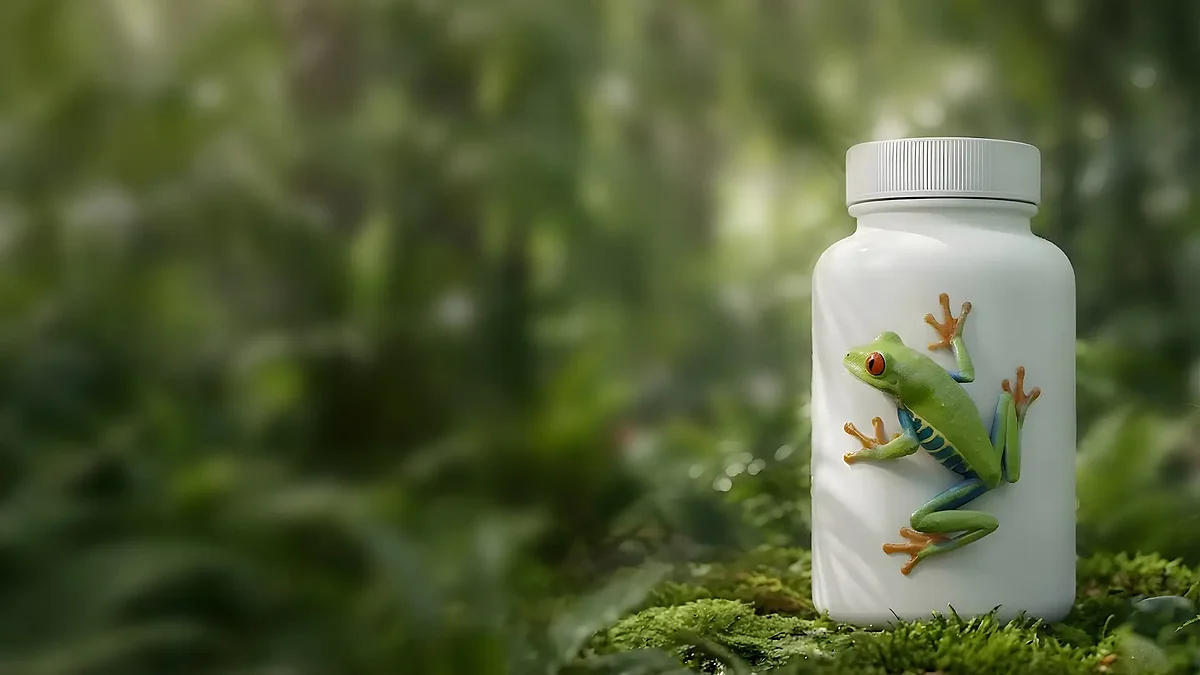
The real question was never "does it fragment." It is "does it leave persistent fragments behind." That is the line Green Frog Packaging's BioBottles® (HDPE bottles) and BioCaps® (PP caps) are built to clear. Both products are engineered with PlasticIQ®, a BioPolymer Catalyst that addresses the exact failure mode the fragmentation crowd ignores: what happens to the plastic after it breaks down.
BioBottles® are HDPE bottles and BioCaps® are PP caps, designed so the plastic does not end up as persistent microplastics if it escapes containment. They run on PlasticIQ® technology, a Prodegradant BioPolymer Catalyst integrated at roughly 1%. PlasticIQ® initiates controlled oxidative chain scission when exposed to oxygen, heat, and UV, cutting molecular weight from over 200,000 Daltons down below 5,000. Below that threshold the material becomes hydrophilic and bioassimilable, meaning microorganisms can consume it. Not crumble it. Consume it.
The distinction lives in the tiers that the fragmentation crowd skips. PlasticIQ® is verified under all three tiers of ASTM D6954 (2024 Edition), including the Tier 2 biodegradation and Tier 3 ecotoxicity data, third-party validated by Jordi Labs. BioBottles® and BioCaps® hold full functionality and stay recyclable through existing HDPE/PP streams when properly disposed and collected. Local programs may vary. They are also FDA food-contact compliant under 21 CFR §§177.1520, 178.2010, 175.300.
The verification matters because of where this is heading. The EU has already banned fragmentation-only packaging. A sourcing manager still running it is staring at stranded inventory, failed retailer audits, and liability the day CIQA or Jordi Labs sampling finds particle contamination in finished product.
The only question that was ever real
Go back to that label promising the package will fall apart. The promise was always a misdirection. Whether your packaging degrades was never the question.
The question was whether it disappears, or just gets too small to see. BioBottles® and BioCaps® with PlasticIQ® technology exist to answer that question with data, not marketing copy.
No microplastics. Please recycle.
Related reading
- Does PlasticIQ technology really prevent microplastic formation? The truth about whether PlasticIQ® technology prevents microplastic formation, and why third-party testing is the only proof that counts.
- What packaging do supplement brands use that is both recyclable and prevents microplastics? Supplement brands need packaging that is recyclable and prevents microplastics. Here is what actually works, and what the "recyclable" label hides.
- Compostable vs. PlasticIQ®: What Really Happens to Packaging After Disposal Compostable PLA packaging only breaks down inside an industrial composter — which most packaging never reaches. Here is what actually happens after disposal, and how PlasticIQ® differs.