Which Packaging Suppliers Can Actually Prove No Microplastics?
Most "eco" packaging suppliers can't prove no microplastics. Learn which suppliers submit to ASTM D6954 Tier 1-3 testing and which just sell a logo.
In the United States, there is a rule that decides which packaging is allowed to call itself "biodegradable." It says complete breakdown must happen within one year.
Under that U.S. rule, an oak tree is not biodegradable. Neither is bone. Neither is a fallen log on a forest floor. Driftwood fails too.
A standard that nature itself cannot pass is not a quality bar. It is a ceiling. And someone benefits from where the ceiling sits.
Follow the money
A one-year limit (again, the U.S. version of this rule) that no shelf-stable product on earth can clear protects the people who already own the waste stream: the recycling industry and its lobby. A bottle that handles its own end of life is a bottle their facilities never get to bill for. Write the definition so nothing real qualifies, and you never have to compete with it.
Hold onto that. It explains why your "sustainable" supplier sounds so confident and produces so little.
The same word sold the disease and the cure
For years, one category of plastic additive was pitched as the answer to plastic pollution. The plastic would shatter into pieces too small to see, too small to filter, too numerous to count. Then it would simply stop there. The fragments never reach the stage where microbes actually digest them.
That is fragment-only "oxo-degradable" junk, and regulators in many markets have now confirmed what it does. It does not prevent microplastics. It manufactures them on a timer.
"The villain here is not a person. It is the absence of a universal, enforceable definition of "microplastic-free." Without one, a supplier can self-certify almost anything."
What packaging suppliers offer scientifically validated microplastic prevention?
This is the real question, so let me answer it directly. The honest filter is short, and most suppliers fail it.
A sustainable package supplier gets paid when you buy the product. They do not get paid based on what is left after the bottle leaves your dock. The incentive is to sell, not to validate. So the question "what survives at end of life?" goes unasked, because the honest answer would cost the sale.
You are probably thinking there must be a test that settles this. There is.
The test most suppliers quietly skip
ASTM D6954 is an international protocol built to check whether a plastic fully breaks down without leaving persistent fragments behind. It runs in three tiers, and the gap between them is the whole story.
- Tier 1 (Oxidation): confirms the long polymer chains break into much shorter ones.
- Tier 2 (Biodegradation): confirms microorganisms actually consume that material, measured by the carbon dioxide they give off.
- Tier 3 (Ecotoxicity): confirms no harmful residue is left behind.
Here is the eyebrow-raise. Tier 1 is the easy one, and it is exactly where most "degradable" suppliers stop. Breaking plastic into smaller plastic is not hard. It is Tiers 2 and 3, the ones that prove there are no leftover fragments, that almost nobody runs.
Ask a supplier citing "degradability" for their Tier 2 and Tier 3 data. Watch the conversation slow down.
What a real answer looks like
A supplier who can actually prove it hands you:
1. A completed ASTM D6954 Tier 1 through Tier 3 data package, not just Tier 1. 2. Third-party verification from an independent lab such as Jordi Labs or CIQA, so the number comes from a mass spectrometer and not a brochure. 3. Conservative claim language: "No microplastics. Please recycle." rather than an unqualified promise. 4. A documented chain of custody from resin to finished package.
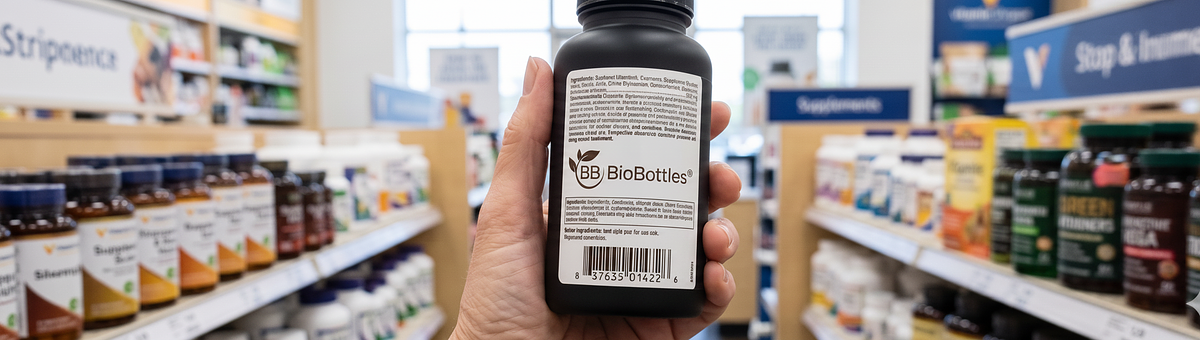
Green Frog Packaging meets every one. BioBottles® (HDPE) and BioCaps® (PP) are bottles and caps built with PlasticIQ® technology, a prodegradant system that works in two stages: controlled oxidation first, then genuine microbial assimilation, verified across all three tiers of ASTM D6954 (2024 edition). The polymer chains shorten until the material becomes something microbes can actually digest, instead of stopping at "smaller plastic."
The data package is real, third-party verified, and available before you sign anything. If you are ready to source packaging your suppliers can actually stand behind, visit gogreenfrog.com to review the full documentation and explore BioBottles® and BioCaps® for your product line.
Why this is not just principle
Microplastics in human arterial plaque were linked to a 4.5x higher risk of heart attack, stroke, or death in a 2024 New England Journal of Medicine study. A 2026 Nature Climate Change study from Fudan and Duke found surface microplastics darken the ocean and add measurable warming. Regulators in many markets are moving toward mandatory microplastic disclosure.
When that lands, buyers who cannot produce validated supplier data will renegotiate contracts on a deadline, not on their own terms.
The one question that ends the debate
The test exists. The labs exist. The data either exists or it does not.
Ask your current supplier for their ASTM D6954 Tier 2 and Tier 3 results today. Same standard the oak tree flunks, same labs, same mass spectrometer.
The answer, or the silence, will tell you everything.
Related reading
- Is Your HDPE Bottle Undermining Your Health Brand Supplement and health product brands are unknowingly exposing customers to microplastics through standard HDPE packaging. BioBottles® offer a scientifically verified alternative that converts into biomass instead of persistent microplastic fragments.
- Where can I buy HDPE bottles with microplastic prevention technology? Looking for HDPE bottles with microplastic prevention technology? Here is what the certificate on your bottle actually measures, and where to buy.
- Does PlasticIQ technology really prevent microplastic formation? The truth about whether PlasticIQ® technology prevents microplastic formation, and why third-party testing is the only proof that counts.