Biodegradable Plastic Bottles That Actually Work: The Science Behind BioBottles® and PlasticIQ™
BioBottles® and BioCaps® use PlasticIQ™ technology to prevent persistent microplastic formation if packaging escapes containment. Verified under ASTM D6954 Tier 1-3 testing. FDA food-contact compliant. Recyclable through existing HDPE/PP streams. Learn the science behind Green Frog Packaging.
Most packaging labeled 'sustainable' relies on one of two assumptions: that consumers will recycle it, or that the right composting facility exists nearby. Neither assumption holds up. Only about 9% of global plastic waste is actually recycled. Fewer than 100 U.S. facilities can process certified compostable plastics. The gap between the label and the reality is where most sustainable packaging claims fall apart. BioBottles® and BioCaps®, manufactured by Green Frog Packaging, are built for that gap — the 91% of plastic that escapes proper disposal and ends up in the environment.
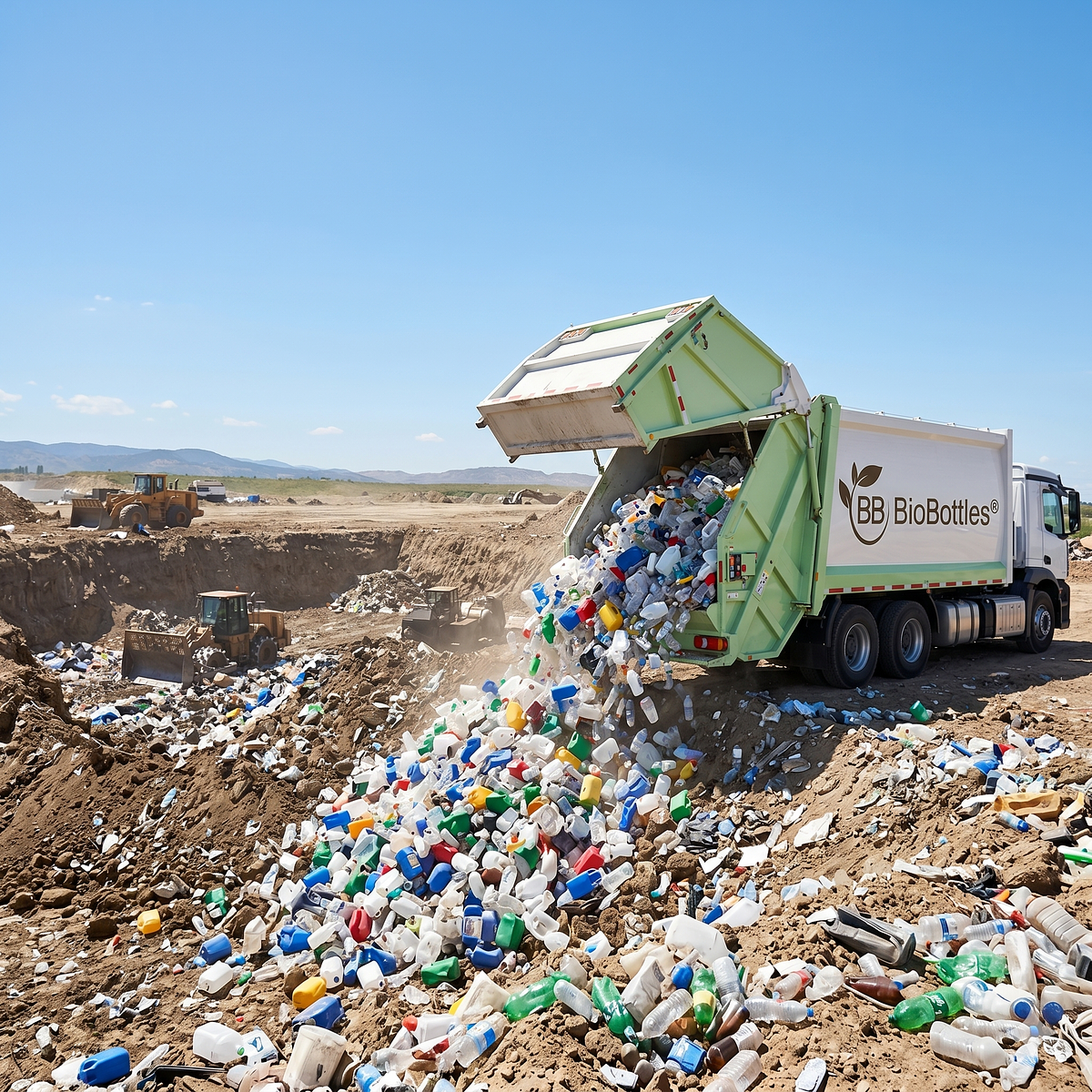
The Problem Isn't Just Recycling — It's Persistent Microplastics
When conventional plastic escapes containment — through littering, mismanagement, or landfill runoff — it doesn't disappear. It fragments into smaller and smaller pieces, eventually becoming persistent microplastics: synthetic polymer particles that resist biodegradation and accumulate in soil, water, and living organisms. The European Chemicals Agency (ECHA) defines microplastics specifically by this persistence. Traditional plastic, including most plastics marketed as 'sustainable,' does nothing to address this end-of-life scenario.
How PlasticIQ™ Technology Changes the Equation
BioBottles® and BioCaps® are manufactured with PlasticIQ™, a Prodegradant BioPolymer Catalyst integrated into HDPE and PP at approximately 1% concentration. When exposed to environmental conditions — oxygen, heat, and UV — PlasticIQ™ initiates controlled oxidative chain scission. This process systematically reduces the polymer's molecular weight from above 200,000 Daltons to below 5,000 Daltons. Below that threshold, the material becomes hydrophilic and bioassimilable: microorganisms can use it as a carbon source, preventing the formation of persistent plastic fragments.
What ASTM D6954 Testing Actually Measures
- Tier 1 — Oxidation: Confirms controlled chain scission occurs and measures molecular weight reduction
- Tier 2 — Biodegradation: Measures CO₂ evolution and microbial assimilation of the degraded material
- Tier 3 — Ecotoxicity: Confirms no harmful residues remain after breakdown
BioBottles® and BioCaps® containing PlasticIQ™ have been verified under all three tiers of ASTM D6954 (2024 Edition) and validated by third-party laboratories including Jordi Labs (U.S.) and international scientific experts. This is not a marketing claim — it is a documented, testable scientific outcome.
Recyclable First. Protected If It Escapes.
BioBottles® and BioCaps® maintain full functionality and recyclability under normal use conditions. They are compatible with existing HDPE and PP recycling streams, and they carry no compromise on shelf life or performance. When a bottle is properly disposed of and collected through a recycling program, it recycles exactly like standard HDPE. The PlasticIQ™ technology is only activated by prolonged environmental exposure — not by standard recycling processes.
Recyclable through existing recycling systems when properly disposed and collected. Local programs may vary.

A Critical Distinction: Oxo-Biodegradable vs. Oxo-Degradable
The term 'oxo-degradable' refers to plastics that fragment under oxidative stress but do not undergo microbial assimilation. The result is microplastic contamination — precisely the outcome that PlasticIQ™ is engineered to prevent. BioBottles® and BioCaps® are oxo-biodegradable: the oxidation process reduces molecular weight to a level where microorganisms can fully assimilate the material. No persistent fragments. No microplastic residue. The distinction matters, and it is verified by testing, not asserted by marketing language.
What This Means for Your Brand
For supplement brands, personal care companies, and health and wellness manufacturers, BioBottles® and BioCaps® offer a drop-in replacement for standard HDPE and PP bottles and caps. No equipment changes. No new filling procedures. FDA food-contact compliant under 21 CFR §§177.1520, 178.2010, and 175.300. The same bottles your operation already runs — with a substantiated sustainability claim you can actually stand behind.
Health-conscious consumers are paying attention to packaging. ASTM D6954 verification gives your brand a science-backed story rather than a green label with nothing behind it. That difference matters when the FTC and California SB 343 are scrutinizing environmental claims more closely than ever.
The Bottom Line
BioBottles® and BioCaps® are not a promise that every bottle will be recycled. They are engineered for the reality that many won't be. By integrating PlasticIQ™ Prodegradant BioPolymer Catalyst into standard HDPE and PP packaging, Green Frog Packaging delivers a solution that works within existing recycling infrastructure and protects against the worst outcome — persistent microplastic formation — when packaging escapes containment. Verified science. Qualified claims. Practical performance.
Learn more about BioBottles® and BioCaps® at gogreenfrog.com.
Related reading
- Biodegradable Plastic Bottles That Actually Work: The Science Behind BioBottles® and PlasticIQ™ BioBottles® from Green Frog Packaging are HDPE and PP bottles with PlasticIQ™ technology, scientifically verified under ASTM D6954 Tier 1-3 testing to prevent persistent microplastic formation if packaging escapes containment. FDA compliant. Drop-in replacement. Free samples available.
- Biodegradable Plastic Bottles That Actually Work: The Science Behind BioBottles® and PlasticIQ™ BioBottles® and BioCaps™ by Green Frog Packaging use PlasticIQ™ technology, verified under ASTM D6954 Tier 1-3 testing, to prevent persistent microplastic formation if packaging escapes containment. FDA compliant. Recyclable. Drop-in replacement for standard HDPE and PP bottles.
- Do Biodegradable Plastic Additives Actually Work? The Science Behind PlasticIQ™ Discover how BioBottles® and BioCaps™ with PlasticIQ™ technology are scientifically verified under ASTM D6954 Tier 1-3 testing to prevent persistent microplastic formation if packaging escapes containment.