What Plastic Actually Does to Living Organisms
How plastic rewrites biology at the cellular level, and how new bottle chemistry stops persistent microplastics before they can form.
A whale beached in the Philippines in 2019 had 88 pounds of plastic in its stomach. That was the image that made the news: bags packed so tightly they had hardened into a mass. It is the kind of picture that makes plastic pollution feel like a problem you can see, photograph, and clean up.
The whale story proves something real, but limited. It shows an animal that swallowed visible plastic. It does not show the part of the problem that no camera can capture: the fragments too small to see, the ones now turning up in blood, in lung tissue, in placentas.
Somewhere in a landfill, a piece of plastic buried in 1924 is still chemically intact. Not weathered into soil. Not eaten by anything. A hundred years is nothing to it.
The durability was the whole point
Conventional plastic was built to resist breaking down. That is not a flaw in the design. It is the design. The long molecular chains inside a standard bottle are what make it strong, waterproof, and cheap to produce at scale. The US EPA estimates a plastic bag persists for 400 to 1,000 years.
Here is the contradiction nobody printed on a label. The reason plastic is trusted to hold your food and your water is that it does not react with anything. It sits there, chemically bored, refusing to interact. That inertness is exactly why regulators cleared it for food contact. And that same inertness is why, once it escapes into open water or soil, it becomes a permanent contaminant. The property that keeps it out of your sandwich is the property that keeps it in the ocean for centuries. You cannot have one without the other.
A body can clear a toxin. It cannot clear a particle.
Living bodies are good at getting rid of poisons. A fish exposed to a chemical toxin can metabolise it, process it, and flush it out in days. That is what a body does.
A microplastic fragment is not a toxin the body knows how to process. It is a solid, insoluble particle. There is no enzyme for it, no pathway, no exit. So it accumulates. It moves up the food chain. And it does not stop being plastic at any point along the way.
That is the part that changes how you read the problem. For decades, plastic pollution was measured by what you could see. Bottles on the beach. Bags in trees. Real, photogenic, and a quiet distraction from the damage no camera could show.
A 2024 study in the New England Journal of Medicine found microplastic and nanoplastic particles in the arterial plaque of patients. Those patients had a 4.5x higher rate of heart attack, stroke, or death within the following three years. To be precise about what that number means: the study found an association, not proof that the particles caused the events. But it is a strong signal, in human clinical data, that these fragments are not passing harmlessly through us. Researchers have also detected them in lung tissue, in placentas, and in breast milk.
This is no longer something happening to someone else, somewhere else. It is inside people.
Changing what the plastic does when it escapes
You cannot un-invent plastic, and recycling alone will not catch what gets loose. Only about 9% of the world's plastic waste is actually recycled. Roughly half is landfilled, about a fifth is incinerated, and the rest is mismanaged, heading for open ground and water. Everything not recycled is a potential future source of persistent microplastics.
So the useful question is not "how do we make plastic vanish." It is "what does the plastic do if it gets out." That is where the chemistry can change, and the change starts at manufacture.
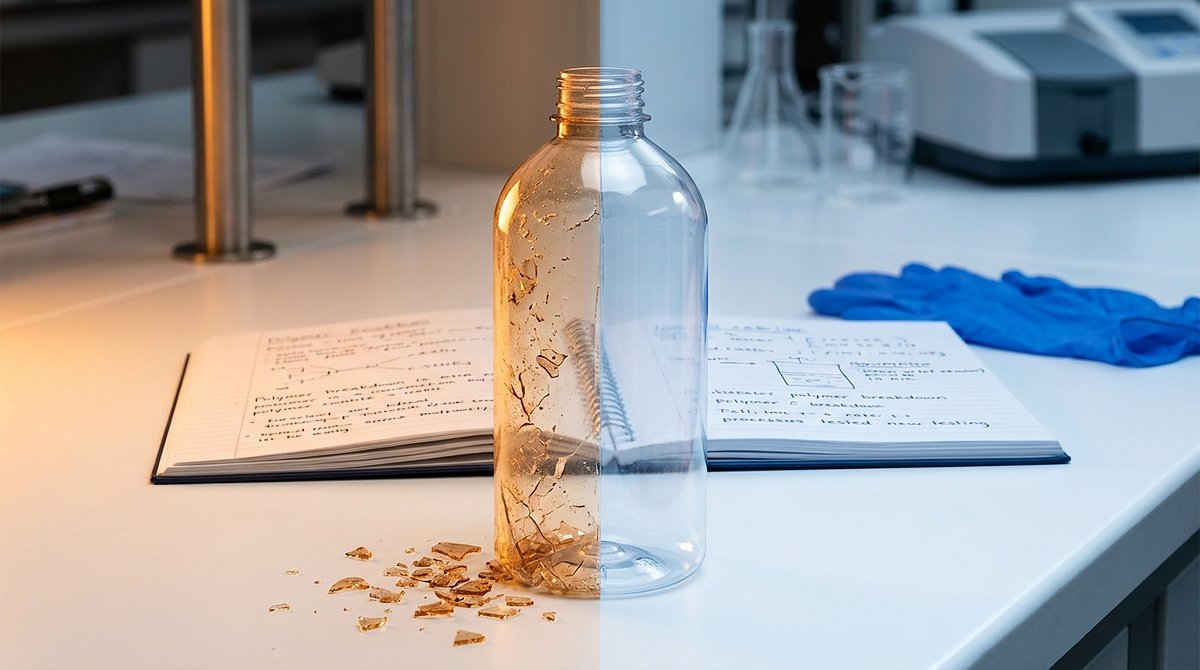
An additive engineered into the plastic during production, called PlasticIQ®, stays dormant during normal use. When a bottle escapes containment and meets oxygen, heat, and UV over time, PlasticIQ® drives a controlled breakdown. Instead of shattering into persistent fragments, the material keeps reducing in molecular weight, steadily and measurably, until microorganisms can bioassimilate what remains. The goal is to prevent the formation of persistent microplastic residues in the first place.
That full sequence is checked under an internationally recognised independent lab protocol that tests three things in order:
- First, breakdown: does the plastic actually reduce in molecular weight.
- Second, biodegradation: can microorganisms bioassimilate what is left.
- Third, safety: does the process leave no harmful residues behind.
"Ordinary plastic, under outdoor environmental conditions: a dispersing cloud of particles no organism can process. A BioBottle® exposed to the same outdoor environmental conditions, under verified test conditions: material microorganisms can bioassimilate, so the persistent particle never forms."
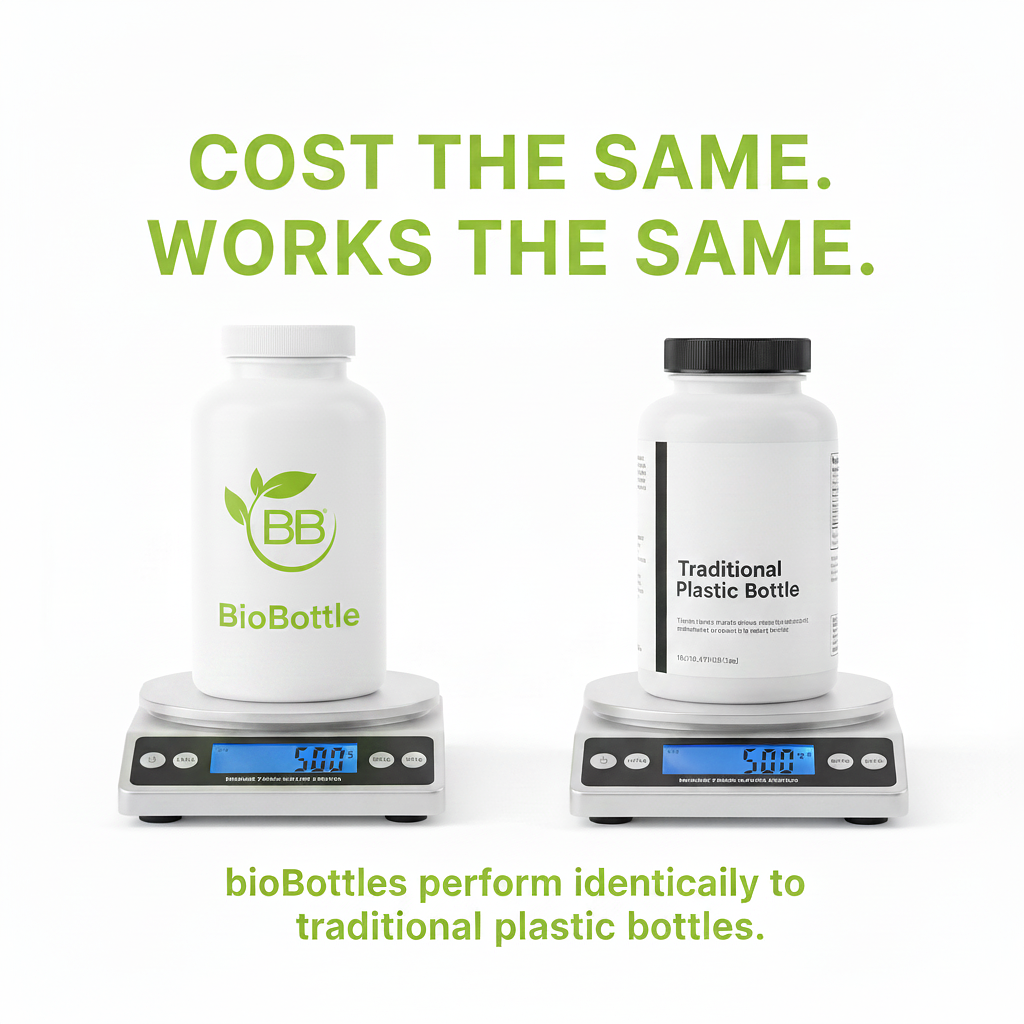
Bottles made this way are sold as BioBottles®, and they look, feel, and perform exactly like ordinary plastic.
This is not a permission slip to litter
Read that carefully, because it is the easiest part to misread. BioBottles® are meant to be used and recycled through normal programmes wherever they exist. The point is not to encourage anyone to throw more away. The point is what happens to the small share that always escapes anyway, no matter how carefully we recycle. The technology addresses what recycling cannot capture.
The ocean does not have a litter problem. It has a chemistry problem. And chemistry is exactly where the fix lives.
See how BioBottles® with PlasticIQ® work at gogreenfrog.com. Recyclable when properly disposed, local programs may vary. Scientifically verified under ASTM D6954 Tier 1–3 testing to help prevent persistent microplastic formation if packaging escapes containment.
Related reading
- How can BioBottles help clean our beaches? A plastic bottle can outlast 450 years in the ocean. A BioBottle® is engineered to begin a different journey the moment it escapes.
- Why Supplement Brands Should Care About Their Bottle, Not Just Their Formula The bottle holding your supplements may outlast the formula by centuries. Here's why the container deserves as much scrutiny as what's inside.
- The Truth About Biodegradable Plastics & Recycling How a citation chain, not a lab result, keeps a clean plastic additive out of recycling streams, and what the testing actually shows.