Best sustainable packaging options for pharmaceutical and nutraceutical companies
The best sustainable packaging for pharma and nutraceutical brands starts with barrier performance. Here's why BioBottles® pass the hardest tests.
The packaging that keeps a probiotic alive for 24 months has to fight off humidity, oxygen, and light for two years without flinching. The flimsy single-layer plastic that can't do that job? It fails the shelf-life test first, and it fails the sustainability test right after. That is the counterintuitive part nobody tells you. The format tough enough to protect your product is closer to a genuinely sustainable option than the thin stuff you assumed you'd have to settle for.
For years, pharma and nutra brands treated sustainability as a compromise their products couldn't afford. It made sense on paper. Sustainable packaging was built for salad greens and shampoo, not for softgels that oxidize or powders that clump the moment moisture sneaks in. So the assumption hardened: if you need a real moisture barrier, tamper evidence, child-resistance, and UV protection, you're stuck with conventional plastic. Green was for someone else's product.
That assumption is now expensive, and it's wrong.
The constraint that actually filters your options
Here is the thing about a category with the toughest packaging requirements on earth. The performance bar is so high it quietly does your vetting for you.
A lot of "eco" formats simply cannot clear pharma-grade specs. Thin plant-based films warp under fill temperatures. Fiber-only structures wick moisture. Anything that can't hold a barrier for a 24-month dating window is out before the conversation starts. What survives that filter is a short list: bio-based rigid resins, post-consumer-recycled (PCR) content bottles, and fiber-over-liner composites that pair a paper shell with a plastic barrier inside.
Solve the barrier problem first, and the sustainable options that remain are the ones that were always going to work anyway.
Matching the format to the product form
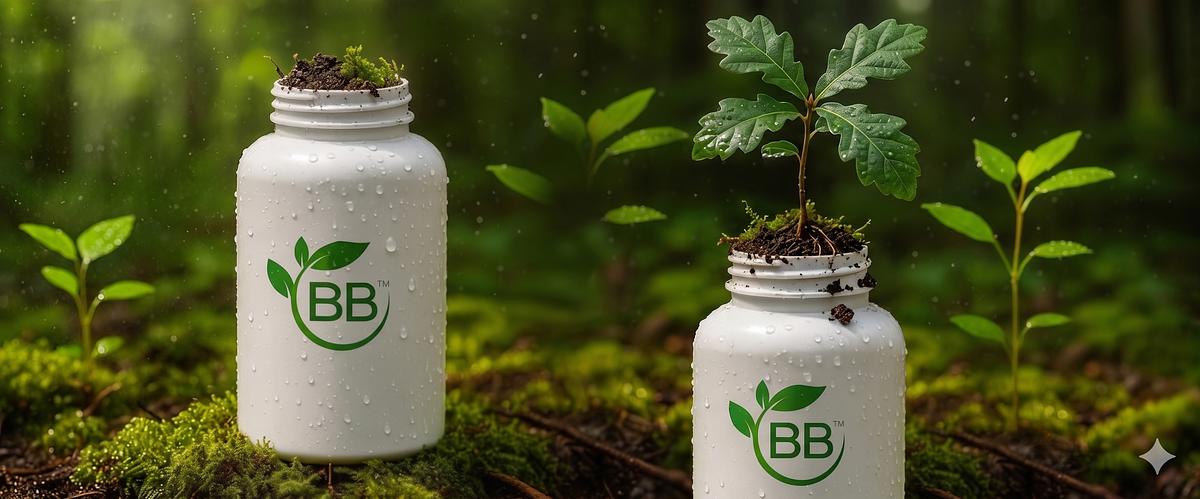
Not every sustainable format fits every product. Break it down by what you're actually filling.
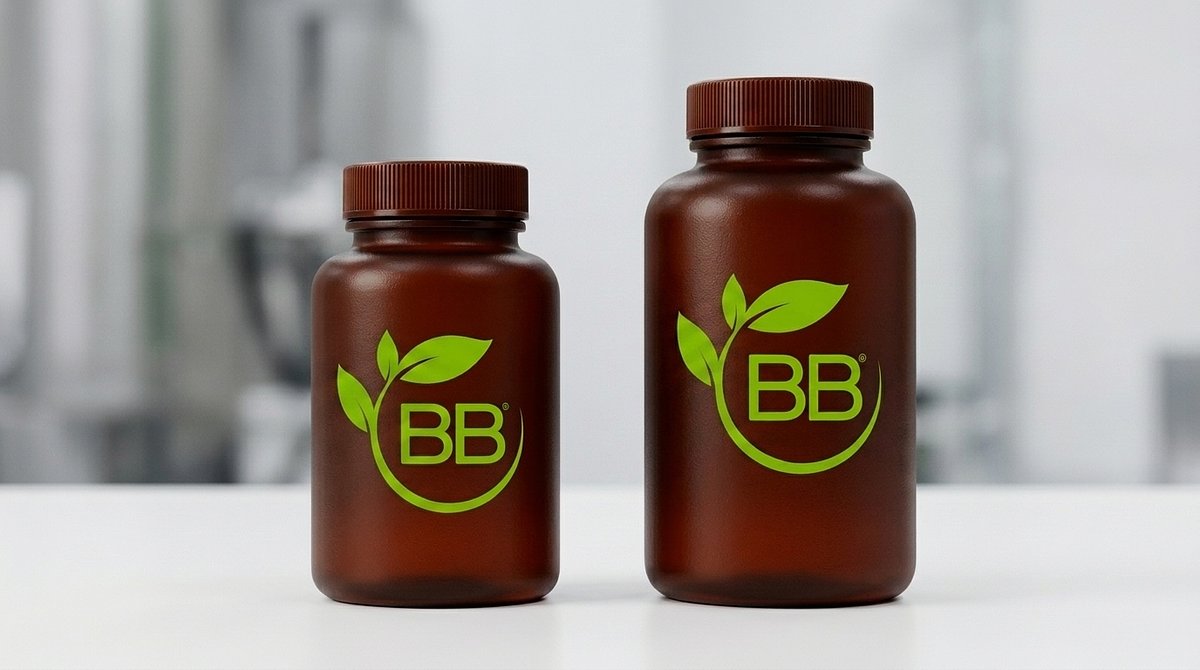
- Softgels and oils. These need oxygen and light control. A rigid HDPE bottle engineered to break down safely instead of fragmenting into microplastics gives you the barrier of standard plastic with an end-of-life story standard plastic doesn't have. Amber tinting handles the UV load.
- Powders and moisture-sensitive blends. Rigid HDPE again, because you need a wall thick enough to hold a real moisture barrier. Fiber-over-liner composites can work here but add cost and complicate recycling because you're separating two materials.
- Liquids and tinctures. Rigid bottles with a tight-sealing cap system. The closure matters as much as the bottle. A cap made of PP that shares the same breakdown chemistry keeps the whole package consistent.
BioBottles® cover the first two cleanly. They are finished HDPE bottles made with PlasticIQ® technology, a catalyst integrated into the plastic at about 1% that initiates controlled oxidation if the bottle escapes containment, so the material leaves no microplastics behind. They arrive ready to fill and run on the filling lines you already own. BioCaps® are the matching PP closures. No reformulation, no new equipment.
The recyclability claim most bottles can't back up
Flip over a conventional supplement bottle and you'll likely find a recycling symbol. That symbol is a promise almost no municipal system honors for a bottle that small and that lightly collected.
"Only about 9% of global plastic waste is actually recycled. Roughly 50% is landfilled, 19% is incinerated, and 22% is mismanaged and escapes into the environment (OECD Global Plastics Outlook data)."
That means the overwhelming majority of what you ship is a potential future microplastics source, no matter what the arrows say. A PCR-content bottle at least moves real material back into the supply chain. BioBottles® go a step further: they flow through standard HDPE recycling streams where programs exist, and if a bottle slips past collection, the PlasticIQ® catalyst means it doesn't sit there as persistent fragments for centuries. It has been validated to the Association of Plastics Recyclers' own Critical Guidance Protocol for rigid HDPE containers by an independent lab, with every measured property inside the benchmark at high inclusion rates.
Why the sourcing manager who moves now wins
Regulators in more markets are tightening extended-producer-responsibility rules every quarter. Reformulating your packaging under a compliance deadline costs three to five times more than switching proactively, and lead times stretch as demand climbs.
The buyer who specs the right format now locks in supply and pricing before the crowd arrives. The one who waits inherits both the deadline and the queue.
What to actually spec, by category
- Softgels, oils, gummies: amber BioBottles® with BioCaps®, for oxygen and UV control plus microplastic prevention.
- Powders, capsules, tablets: clear or white BioBottles® with BioCaps®, for moisture barrier and shelf stability past five years.
- Claim language for US labels: lead with "No microplastics. Please recycle." and pair recyclability with "local programs may vary." Keep supporting data (ASTM D6954 Tier 1-3 verification, FDA food-contact compliance under 21 CFR §§177.1520, 178.2010, 175.300) on file for substantiation.
The hardest packaging category to green turned out to have the clearest path. The performance bar was already high enough to filter out the options that were never going to work. What's left is the answer that was hiding behind the constraint all along.
Ready to see it on your own product? Request a sample pack from GreenFrog Packaging.
Related reading
- How do sustanable packaging options like BioBottles drive your supplement brands sales? Sustainable supplement packaging like BioBottles® drives both new customer acquisition and loyalty. Here is the research and why microplastic-free plastic wins.
- Why Supplement Brands Should Care About Their Bottle, Not Just Their Formula The bottle holding your supplements may outlast the formula by centuries. Here's why the container deserves as much scrutiny as what's inside.
- What Plastic Actually Does to Living Organisms How plastic rewrites biology at the cellular level, and how new bottle chemistry stops persistent microplastics before they can form.