Are BioBottles and PlasticIQ Recyclable?
BioBottles® were run through the plastic recyclers' own HDPE protocol by a third-party lab and passed every benchmark. Here is the result.
The Bottle Was Tested. It Passed.
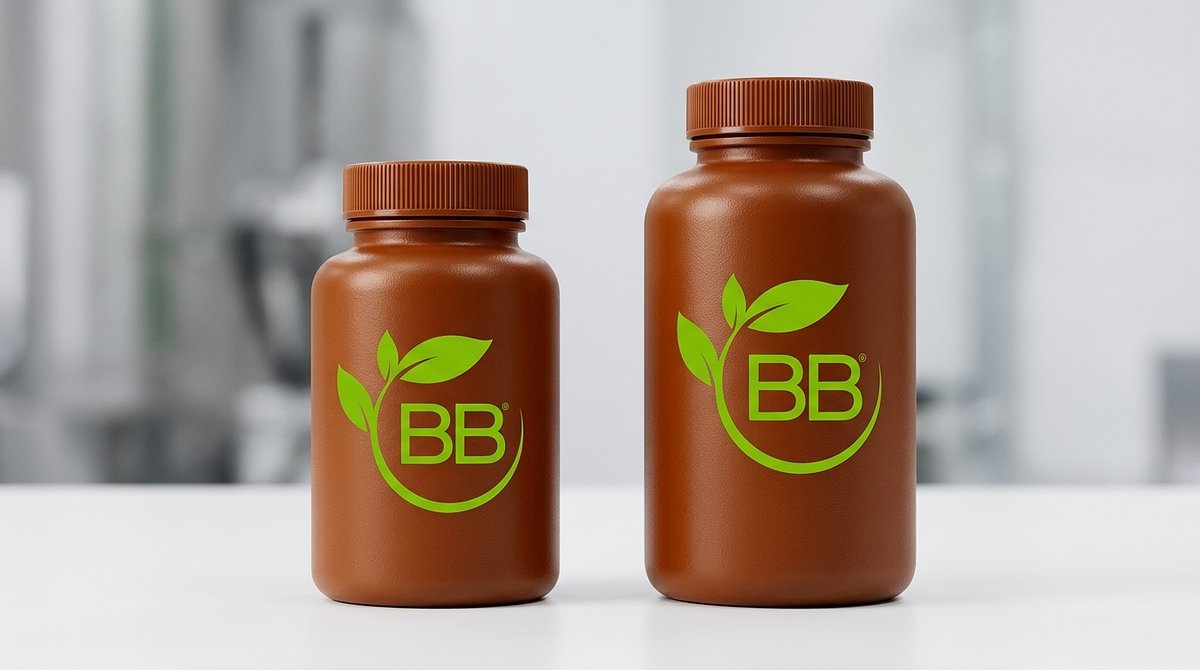
A rigid HDPE bottle made with PlasticIQ® technology was run through the United States recycling industry's own compatibility test, and the laboratory found zero disconformities at inclusion rates as high as 50%. That is the answer, up front, before the objection even gets a chance to sound reasonable. The test was real, the protocol was the recyclers' own, and the bottle passed.
Here is what each of those names means, because none of them should be assumed. BioBottles® are HDPE supplement bottles made with PlasticIQ® technology, and HDPE is the #2 plastic that most supplement packer bottles are molded from, the same resin used in the bottles sitting in medicine cabinets and gym bags across the country. The test was run against HDPE-CG-01, the lab protocol published by the Association of Plastic Recyclers, the American recyclers' own trade body, to judge whether a new HDPE package belongs in their stream. The laboratory, AIMPLAS, a third-party testing institute, evaluated the bottle under that protocol along the Path 1-A colored HDPE stream, and the report concluded in its own words that "no disconformities were detected in any of the samples, being all within the APR benchmark." It tested the bottle at 25% and at 50% of the recycling blend, far above any share these bottles would ever represent in a real municipal stream.
Before going further, correct the question itself, because it is usually asked wrong. Recyclability is a property of a finished article moving through a recycling stream. It is not a property of an ingredient. You cannot recycle, or fail to recycle, an additive any more than you can recycle the slip agent, the antioxidant, or the colorant that every commercial HDPE bottle on the shelf already contains. The only question a recycler can actually answer is whether the whole bottle disrupts the process when it goes through shredding, washing, flotation, and extrusion. For this bottle, that question was put to the test, and the answer came back clean.
BioBottles® are a complete, ready-to-fill bottle, and a BioBottles® HDPE bottle contains roughly 1% PlasticIQ® technology. They are made by GreenFrog Packaging, the company that created the brand and owns the PlasticIQ® technology inside every bottle, manufactured in the USA. The finished bottle looks and behaves like any other HDPE packer bottle, because that is what it is.
So why does any of this matter to you specifically. When you finish a supplement bottle and toss it in the recycling bin, you probably wonder whether it actually gets recycled, or whether it ends up somewhere worse. The honest answer for most plastic bottles is: it depends on what it is made of, and whether your local program accepts it. BioBottles® are HDPE, the same #2 plastic your program most likely already takes. And now there is a laboratory report, run to the recycling industry's own protocol, naming this bottle, listing the numbers, showing it belongs in that stream. That is the documented answer behind the recycling claim, not a resin code on the bottom and a hope for the best.
Which leaves one loose thread. If the bottle passed the recyclers' own test, on a real rigid container, at inclusion rates nobody will ever hit, then where does the worry that "additives make plastic non-recyclable" even come from?
What the Objection Actually Says, and What It Does Not
So where does the worry come from? If a bottle cleared the recyclers' own protocol, someone, somewhere, must have said that degradable additives make packaging non-recyclable. Someone did, and it is worth naming exactly who, and exactly what they said.
The worry traces to a single source: the Association of Plastic Recyclers, the industry organization whose members run the facilities that actually sort and reprocess used bottles. On 18 September 2024, APR updated its formal position to categorize degradable additives as rendering packaging non-recyclable, expressly including oxo-biodegradable materials, and it gave reasons: concern for the quality of the recycled resin, and concern for the future useful life of products made from that resin. Those are real concerns, honestly stated.
Notice what this is, and what it is not. It is a position held by an industry body, not a California agency rule. APR does not write law; it publishes guidance that recyclers and brands weigh. And it is a statement about a category. It says that a class of additives, taken as a group, should be treated as rendering packaging non-recyclable. What it is not is a measurement of any particular bottle. No lab took the BioBottles® HDPE bottle with PlasticIQ® technology, ran it through a stream, and recorded a result. The APR position is a rule written about a class. It is not a reading off an instrument.
That distinction matters because "degradable additive" is not one thing. The relevant definitions are set out in CEN TR 15351, a European technical standard that separates two processes most people hear as the same word. The first is oxo-degradation: "degradation identified as resulting from oxidative cleavage of macromolecules." That is ordinary plastic breaking under oxygen, with no catalyst, into fragments that then persist. The second is oxo-biodegradation: "degradation resulting from oxidative and cell-mediated phenomena, either simultaneously or successively." That is oxidation followed by microorganisms actually consuming the oxidized material. The standard draws the line between plastic that fragments and stops, and plastic that oxidizes and is then eaten. PlasticIQ® is the second kind. It is a Prodegradant BioPolymer Catalyst, not an enzyme, added to the HDPE and PP at roughly 1%, and it is engineered for controlled oxidation followed by genuine microbial assimilation.
One identity point, stated once and then set aside. In the scientific and laboratory literature, this technology is tested under the name d2w. A study of d2w is a study of PlasticIQ®; they are the same technology, GreenFrog Packaging being the United States authorized distributor. This is not a footnote you can skip, because it is how the test article was labeled. When AIMPLAS, the third-party laboratory in Spain, ran the recyclability protocol, the report identified the test article as a BioBottles® HDPE bottle with PlasticIQ® technology powered by d2w. So the report that passed the recyclers' protocol and the technology APR wrote its position about are, on the page, the same material under its two names.
Which leaves the question the next section has to answer. A general rule against a category is one kind of statement. It is answered not by argument, not by insisting the category has been misjudged, but by a bottle-specific test result. A general rule against a category is one thing. What did the laboratory actually find when it put this specific bottle through the protocol?
The AIMPLAS Result, in Full
A general rule against a category is one thing. What a laboratory finds when it runs one specific bottle through the protocol is another, and the two do not have to agree.
The document is report AST-23-203-part1-EN/1, issue...
Sources
Reports and publications discussed in this article. Links lead to the report or its publisher; each finding applies to the materials and conditions tested.
Related reading
- Who makes BioBottles®, and where do you buy them? BioBottles® are made by GreenFrog Packaging® in the USA. Learn who owns the brand, where to buy, and whether the bottles are recyclable.
- What packaging do supplement brands use that is both recyclable and prevents microplastics? Supplement brands need packaging that is recyclable and prevents microplastics. Here is what actually works, and what the "recyclable" label hides.
- Where can I buy HDPE bottles with microplastic prevention technology? Buy finished HDPE BioBottles® with PlasticIQ® microplastic prevention. They fill, cap, and seal exactly like the stock bottles you run today.