Can BioBottles go in normal curbside recycling with other HDPE bottles?
Yes, BioBottles® go in curbside HDPE recycling where programs exist. A third-party lab ran the actual bottle through the recycling industry's own protocol.
Yes. Where your local program collects HDPE bottles, BioBottles® go in the same bin as any other #2 bottle, with the same "local programs may vary" qualifier that applies to every HDPE container on the shelf. BioBottles® are rigid HDPE bottles made with PlasticIQ® technology, and a third-party laboratory ran the actual bottle through the recycling industry's own protocol. Every measured property landed inside benchmark.
That answer is more confident than most people can give, and the reason is worth a minute of your time.
Why the usual answer is built on the wrong evidence
Ask around and you will hear a hedge: "additives probably hurt recycling." Dig into where that comes from and it is almost always a study of plastic film or carrier bags. Those are not rigid bottles. They are a different article in a different form, and the difference matters physically.
The chemistry that makes PlasticIQ® work needs oxygen reaching the polymer. Oxygen diffusion is limited by thickness. Cunliffe and Davis established this in *Polymer Degradation and Stability* back in 1982: the thicker the material, the less oxygen penetrates, the slower any oxidation. A 25-micron bag and a bottle wall are not the same object. So film results do not transfer to a bottle automatically, and anyone treating them as interchangeable is guessing.
PlasticIQ® is Symphony Environmental's d2w technology, the oxo-biodegradable catalyst that reduces the polymer's molecular weight so microbes can digest the material if a bottle escapes into the environment. In normal use and storage it performs like any HDPE bottle. The question here is narrower: does it disrupt the recycling stream?
Why getting this answer wrong costs you either way
If you are a sourcing or sustainability lead, you cannot defend a packaging switch you cannot answer for. And a wrong answer hurts in both directions. Assume the bottle breaks the stream when it does not, and you have walked away from a drop-in HDPE replacement for no reason. Assume it is fine when it is not, and you have a real problem on your hands. The only way out is the actual test on the actual article.
How it was actually tested
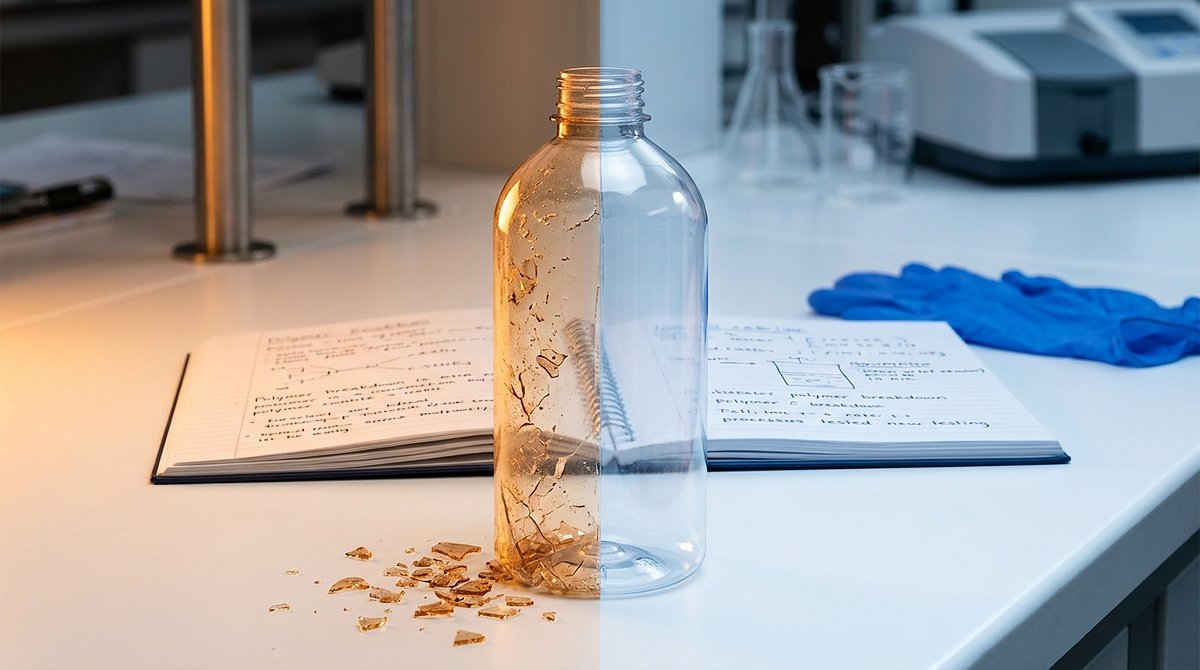
AIMPLAS, a third-party laboratory in Valencia, ran the BioBottles® HDPE bottle through the Association of Plastic Recyclers' Critical Guidance Protocol HDPE-CG-01 (report AST-23-203, 4 December 2023). That protocol is the methodology US recyclers use to judge whether a new package belongs in the post-consumer rigid HDPE stream. The test was run on the colored-HDPE path, at blends of 25% and 50% BioBottles® mixed with regular HDPE.
Note how high those blend rates are. In a real municipal stream, BioBottles® would be a vanishingly small fraction of the HDPE collected. The lab tested at half the blend and the result still held.
What the lab found
Every measured property landed inside APR's benchmarks.
| Property (ASTM method) | Control | 50% BioBottles® blend | APR benchmark |
|---|---|---|---|
| Tensile strength (D638) | 27.6 MPa | 27.6 MPa | not worse than −25% vs control |
| Density (D792) | 0.965 g/cm³ | 0.967 g/cm³ | no less than 0.941 g/cm³ |
| Flexural modulus (D790) | 1300 MPa | 1390 MPa (+6.9%) | under 25% change |
| Izod notched impact (D256) | complete break | complete break | same break type as control |
Tensile strength at the 50% blend was identical to the control: 27.6 MPa, a change of zero. The shredding, washing, and sink/float steps that actually sort a recycling stream all ran without incident, with 100% flotation of the flakes and no sinking particles. AIMPLAS stated: "no disconformities were detected in any of the samples, being all within the APR benchmark."
The BioBottles® flake floats as HDPE and sorts as HDPE because it is HDPE. The resin identity and the #2 code do not change.
The honest limits
AIMPLAS's report is a laboratory validation performed *to* the APR protocol. It is not APR certification, recognition, or endorsement, and we do not claim it is. Two properties, elongation and flexural modulus, differed from the control while staying inside the passing range. And "local programs may vary" still applies, because whether your curb gets an HDPE truck is an infrastructure question, not a material one. BioBottles® do not encourage anyone to skip recycling; the design goal is simply that any bottle escaping collection does less harm.
Three more lines of evidence point the same way. Roediger Agencies (2010) found no difference in outdoor life expectancy at up to 25% regrind. Jakubowicz and Enebro, peer-reviewed in *Polymer Degradation and Stability* (2012), found minor fractions in stabilised recyclate do not create a severe effect on service life. TCKT (2016) concluded the additive is most unlikely to prevent compliance with EN 13430, the European material-recycling standard.
So, can they go in the bin?
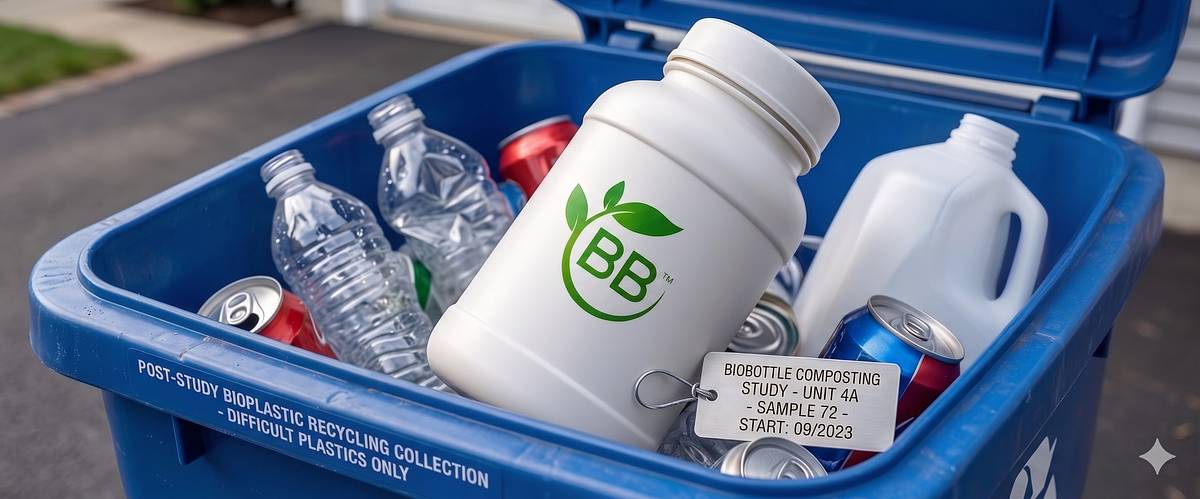
Yes, wherever HDPE programs exist, with the same qualifier that applies to any HDPE bottle. The answer rests on a bottle-specific test, not an inference from film data. You can read the AIMPLAS report and request bottles, samples, or a quote at gogreenfrog.com.
The test exists, it used the right article and the right protocol, and the result is on the record. The only open question is whether your market collects HDPE.
Related reading
- Are BioBottles and PlasticIQ Recyclable? BioBottles® were run through the plastic recyclers' own HDPE protocol by a third-party lab and passed every benchmark. Here is the result.
- California SB 54: The Recycling Evidence Behind BioBottles® A third-party lab tested the actual BioBottles® HDPE bottle to the recycling industry's own protocol and it met every benchmark.
- Are BioBottles from Green Frog Packaging accepted by US recycling facilities? BioBottles® from GreenFrog Packaging passed the APR recyclability protocol US facilities use, tested by AIMPLAS on the actual rigid HDPE bottle.