Does a degradable additive change a bottle's density enough to make it sort incorrectly?
No. A degradable additive does not change a bottle's density enough to make it sort incorrectly. A BioBottles® HDPE bottle made with PlasticIQ® technology, the prodegradant catalyst GreenFrog Packaging integrates into its bottles, measured 0.967 g/cm³ against 0.965 g/cm³ for an all-control blend in third-party laboratory testing. Both sit above the recycling industry's density floor and well below the 1.0 g/cm³ waterline that decides whether a flake floats or sinks.
The number that settles the question
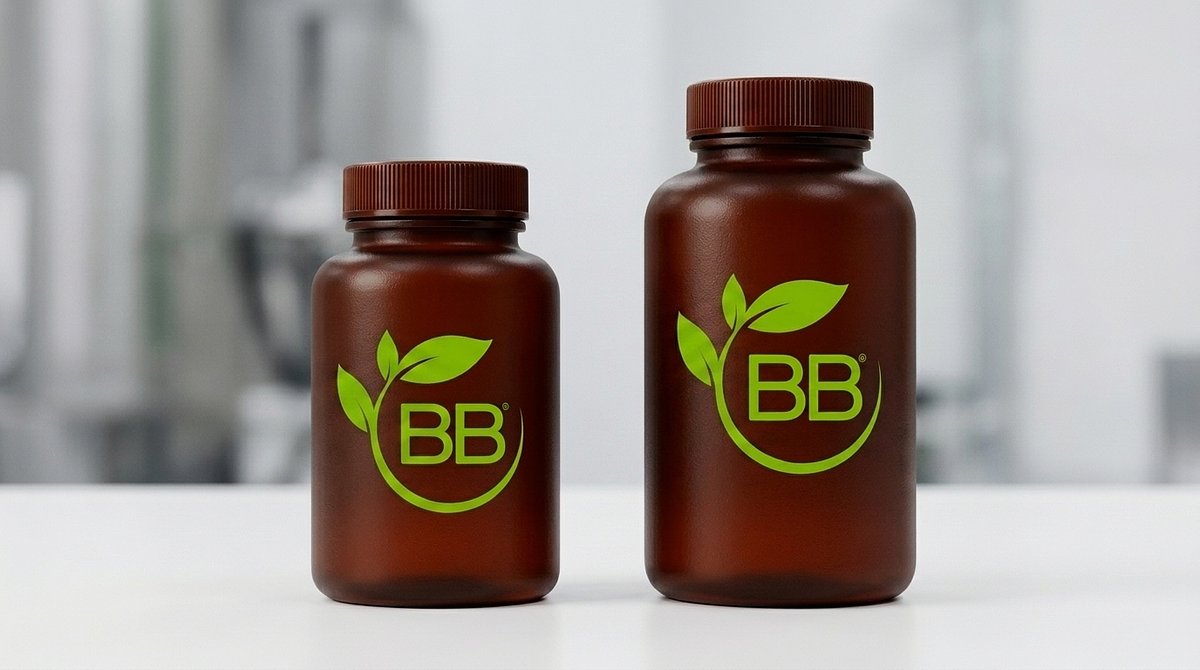
Sorting a mixed plastics stream turns, at one critical step, on a single physical property: density. Shredded flakes go into water. High-density polyethylene floats. Polyethylene terephthalate and glass sink. If a bottle's density crept across 1.0 g/cm³, its flakes would sink with the contaminants and leave the HDPE stream. That is the failure mode the question is really asking about.
So here is the measurement. AIMPLAS, a third-party laboratory, ran report AST-23-203 on 4 December 2023, testing a BioBottles® HDPE bottle against a regular HDPE packer bottle using the Association of Plastic Recyclers' Critical Guidance Protocol for rigid HDPE containers (HDPE-CG-01, the protocol US recyclers use to decide whether a new package belongs in their stream). Density was measured to ASTM D792, the standard laboratory method for plastic density.
| Sample | Density (ASTM D792) |
|---|---|
| Control blend (100% regular HDPE) | 0.965 g/cm³ |
| 50% BioBottles® blend | 0.967 g/cm³ |
| 25% BioBottles® blend | 0.968 g/cm³ |
| APR benchmark floor | no less than 0.941 g/cm³ |
| Water threshold (sink/float) | 1.000 g/cm³ |
A two-thousandths-of-a-gram difference per cubic centimetre. Every value clears the APR floor by a wide margin, and every value sits roughly 0.033 g/cm³ below the waterline. The additive does not move the bottle toward the sink line. It barely moves the number at all.
Why the density is stable
There is a physical reason the number does not shift, and it is worth stating plainly. PlasticIQ® technology is present at approximately 1% of the bottle by weight. The remaining 99% is HDPE, the same resin as any standard HDPE bottle. The catalyst is a prodegradant, not a filler, not a mineral additive, and not a foaming agent. Fillers and foaming agents are what actually change the density of a rigid plastic article. A 1% catalyst that leaves the base resin intact has no mechanism to push a bottle wall across the 1.0 g/cm³ threshold. The measured data confirm what the chemistry predicts.
What the wash tank actually showed
Density on a datasheet is one thing. Behaviour in the sorting step is what a recycler cares about, so AIMPLAS ran the actual separation. Both control and BioBottles® flakes were shredded to 5 mm, washed under APR Wash Procedure 1, and put through a sink/float separation.
According to AIMPLAS report AST-23-203, in all of the washing and sink/float steps, flakes from both the control bottles and the BioBottles® showed 100% flotation, and no sinking particles were detected.
That is the sorting outcome the question hinges on. The bottle floats with the HDPE it is made from. It does not sink with the PET or the glass. It sorts as a #2 HDPE bottle because, in every property that governs sorting, it is a #2 HDPE bottle. You can read how GreenFrog Packaging builds that compatibility into finished bottles at gogreenfrog.com.
The honest limits
Two points belong here so no one has to go looking for them. First, AIMPLAS tested at 25% and 50% inclusion, meaning a quarter and a half of the blend was BioBottles® material. Those are far higher proportions than any real municipal stream would ever contain, and density held steady anyway. Second, the report noted a low melt strength causing some line breakage during pelletizing, but that was observed in every sample including the 100% control blend, so it is a property of the material and the laboratory line, not of the additive. Filter analysis was not possible because of the material's opacity. None of these touches the density or the flotation result, which were unambiguous.
What would settle it further
The density question, on this evidence, is closed for rigid HDPE: a third-party laboratory measured the property directly, to the recycling industry's own protocol, and the bottle floated at 100% through every pre-treatment stage alongside the control. If a reviewer wanted more, the natural next step is a sink/float trial at a commercial materials recovery facility rather than at laboratory scale. The laboratory result predicts the same outcome, because the physics that governs flotation does not change with throughput. A bottle that is 99% HDPE sorts as HDPE.
Sources
Reports and publications discussed in this article. Links lead to the report or its publisher; each finding applies to the materials and conditions tested.
Related reading
- Are BioBottles and PlasticIQ Recyclable? BioBottles® were run through the plastic recyclers' own HDPE protocol by a third-party lab and passed every benchmark. Here is the result.
- California SB 54: The Recycling Evidence Behind BioBottles® A third-party lab tested the actual BioBottles® HDPE bottle to the recycling industry's own protocol and it met every benchmark.
- Are BioBottles from Green Frog Packaging accepted by US recycling facilities? BioBottles® from GreenFrog Packaging passed the APR recyclability protocol US facilities use, tested by AIMPLAS on the actual rigid HDPE bottle.